
The Helper’s Paradox
Why is it that the individuals most dedicated to healing others—the clinicians, first responders, and peer supporters—often find themselves the most broken? It is a profound irony of the helping professions: the very empathy required to do the job effectively can become a conduit for “invisible injuries.” These are not the typical stresses of a demanding career; they are deeper, cognitive, and emotional wounds that occur when the weight of a community’s crisis becomes too heavy for one person to carry alone.
In NOCE’s recent “Helping the Helper” listening session, a panel of experts gathered to peel back the mask of professionalism. They explored why those on the front lines of the opioid epidemic and suicide prevention are fueling the “Great Resignation.” The consensus was clear: what we often dismiss as “burnout” is actually a complex landscape of secondary trauma, moral injury, and functional distress. To sustain our workforce, we must move beyond surface-level self-care and address the systemic architecture that silences those who are “leading while bleeding.”
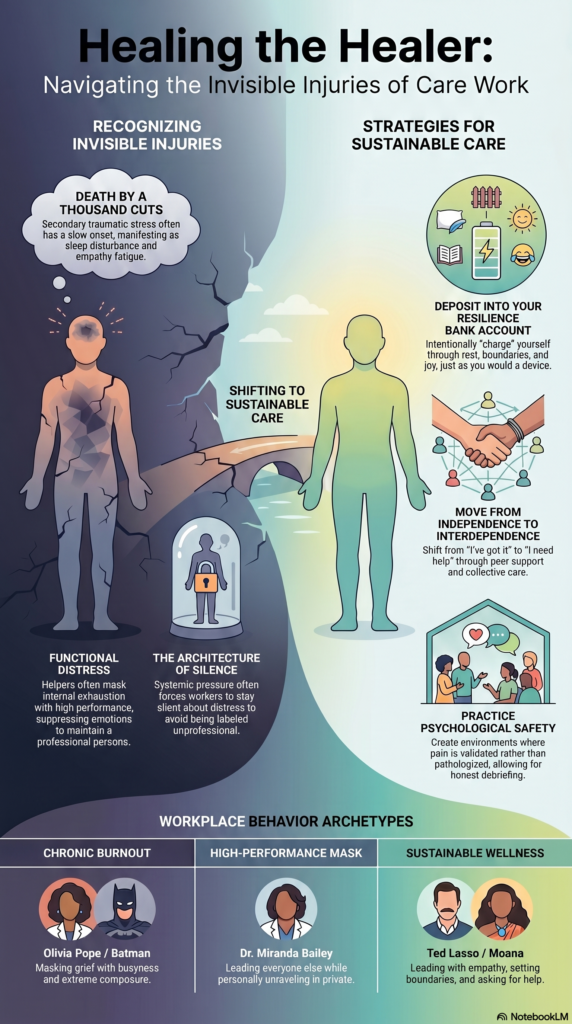
Secondary Trauma is a “Death by a Thousand Cuts”
Dr. Trudy Gilbert-Eliot, a specialist in trauma recovery for first responders, describes Secondary Traumatic Stress (STS) not as a sudden explosion, but as a slow, insidious erosion. For many professionals, STS does not appear after a single catastrophic event. Instead, it builds over five, ten, or fifteen years of service through the constant absorption of other people’s pain.
Because the onset is so gradual, many helpers fail to notice their own decline. They make tiny “micro-adjustments” to their personalities and lifestyles to cope, eventually reaching a point where the coping strategies themselves—such as isolation or withdrawal—become the symptoms of the injury. Perhaps most dangerously, Dr. Trudy notes that in under-resourced systems, we often judge our health by the “sinking boat” analogy. If everyone in the workforce is sinking together, we judge our own wellness by the person doing the worst in the boat, rather than an objective standard of health. When decline becomes the baseline, the injury remains invisible until it is catastrophic.
“It’s kind of like death by a thousand cuts. It’s like you really don’t know how many cuts your body can take before you start to bleed out. And that’s sort of how this works.” — Dr. Trudy Gilbert-Eliot
Beware the Trap of “Functional Distress”
We often evaluate a professional’s health based on their output. If they are meeting quotas and “handling it,” we assume they are fine. Altamit Lewis, a workforce wellness expert, challenges this assumption with the concept of functional distress. This is a state where a person remains highly productive and “on” externally while feeling completely numb, exhausted, or disconnected internally.
In many high-pressure systems, this emotional suppression is actually rewarded and labeled as “professionalism.” This creates an “architecture of silence” where vulnerability is seen as a lack of capacity rather than a requirement for healing. By rewarding the mask, the system punishes the very transparency needed to prevent a total collapse.
- Professionalism (The Mask): Appearing steady, reliable, and “fine” regardless of the internal cost; prioritize output over emotional regulation.
- Functional Distress (The Reality): Internal exhaustion, delayed help-seeking, and the normalization of overwork until the helper reaches a breaking point.
The “Skeleton on the Front Lawn” – Radical Vulnerability in Peer Support
Peer support worker Jewels Crable offers a model for healing that involves moving “skeletons in the closet” to the “front lawn.” In peer work, lived experience—histories of addiction, loss, or trauma—is not a source of shame to be hidden, but the primary tool for connection. However, this requires a radical and disciplined form of vulnerability.
The goal of sharing one’s story is not for the helper’s catharsis, but to provide a “living example” of survival. Crucially, this model rejects the “savior complex.” Resilience in this space is built on the recognition of agency: the understanding that while a helper can hold space and offer resources, they cannot “save” another person. True healing is a choice that the individual must make for themselves. By respecting the other person’s agency, the helper avoids the crushing weight of feeling solely responsible for another’s life or death.
“I always said that I don’t have any skeletons in the closet because they’re always hanging on my front lawn… It’s about connection and we’re required to pull from our story and share it.” — Jewels Crable
The Danger of “Spiritual Bypassing”
In faith-based communities, the pressure to maintain a public persona is often amplified by spiritual expectations. Gabrielle Burton, a specialist in spiritual abuse recovery, warns against Spiritual Bypassing—the practice of using religious platitudes to silence or minimize real human pain. This often results in Spiritual Assault, where leaders or congregants use phrases like “God will give you double for your trouble” to shut down the ambiguity and grief of those in crisis because they are uncomfortable with the pain.
When a leader is “leading while bleeding,” they feel forced to offer a hope they do not currently possess, leading to Moral Injury. This is the internal split between one’s values and the “on” persona required by the institution. Healthy spirituality must allow for “the wrestle”—the space to have questions and feel grief without being judged as “lacking faith.” When the system fails to protect the helper’s right to be human, the resulting moral fatigue becomes an invisible injury that drives people out of service.
Why We Need More Ted Lassos and Fewer Olivia Popes
Our cultural archetypes often glamorize the very behaviors that lead to chronic burnout. To build a sustainable workforce, we must stop rewarding the “solo hero” who survives on unhealed grief and start prioritizing collective care.
Burnout Archetypes
- Olivia Pope (Scandal): The “fixer” who handles everyone’s problems while her own life unravels, rewarding the appearance of control.
- Batman: The hero fueled by unhealed grief, illustrating that relentless busyness is often a mask for avoiding personal healing.
- Anakin Skywalker: A cautionary tale of a system that shames vulnerability and weaponizes sensitivity, eventually turning a helper into a villain through isolation.
Wellness Archetypes
- Ted Lasso: A leader who leads with empathy, is not afraid to seek therapy, and openly names his struggles to create a culture of safety.
- The Golden Girls: A model of community care—shared meals, presence, and the “medicine” of laughter that facilitates collective resilience.
- Issa Dee (Insecure): Represents “wellness in motion” through raw honesty with oneself and the practice of self-reflection (the “mirror talk”).

The Wellness Bank Account: A Strategy for the Future
Resilience is not a fixed trait; it is a “bank account” that requires constant, intentional deposits. To move from solo survival to collective sustainability, we need a tangible roadmap for recovery.
The Resilience Strategy:
- Audit the “Battery”: Adopt Altamit Lewis’s perspective: we are obsessed with the battery life of our technology but ignore our own. We must honor the “charging” of ourselves with the same discipline we give our phones.
- Use Precision Tools: Incorporate practices like the Panda Planner to start the day with gratitude and affirmations, and utilize sound healing or guided meditation to regulate the nervous system.
- The Three Questions: Establish a “Peer Check-in” system where colleagues ask three non-negotiable questions: Did you eat? Did you sleep? How is your heart?
- Embrace the “Woo Woo”: Recognize that healing happens in kitchens, barber shops, and through shared silence—what Altamit calls “unseen technologies of care.”
The Final Thought:
We charge our phones, tablets, and cars every single night to ensure they function the next day. Why don’t we honor the “charging” of ourselves with the same level of discipline? The “Great Resignation” is not a sign of weakness in the workforce; it is a response to a system that asks people to run on empty. How does your system—and your own internal voice—validate your pain, or is it simply asking you to keep running until you bleed out? We must move from extreme independence to a sacred interdependence. After all, you are enough, even at your worst, and you are right on time for your own healing.
Ready to learn more? Listen to The NOCE Dose Season 3
Helping the Helper: Healing the System from Within Compassion Fatigue, Postvention, and Sustainable Provider Wellness
The NOCE Dose: The Opioid Crisis Unplugged Season 3Season three of The NOCE Dose is about the people behind the work—and what it costs to keep showing up. Hosted by Bianca D. McCall, Help the Helper creates space for honest conversations with those carrying the weight of care: clinicians, peers, first responders, and community leaders across Nevada. Together, we explore the realities of burnout, secondary trauma, and the quiet ways helpers lose themselves in the work. This season reminds us that we can’t hide our humanness—and we were never meant to carry everything alone. Through powerful stories and practical insight, listeners are invited to reflect, reconnect, and redefine what sustainable care truly looks like.