
The crisis care system plays a crucial role in addressing the opioid epidemic, providing immediate assistance and support to individuals experiencing opioid-related emergencies. It serves as a vital safety net, offering timely interventions, overdose reversal treatments, and access to medical and psychological support.
Crisis Care Resources
Websites
Pathways in Crisis Services
988 Suicide & Crisis Lifeline – Call. Text. Chat.
The 988 Lifeline provides 24/7, free and confidential support for people in distress, prevention and crisis resources for you or your loved ones, and best practices for professionals in the United States.
SAMHSA’s National Helpline
SAMHSA's National Helpline is a free, confidential, 24/7, 365-day-a-year treatment referral and information service (in English and Spanish). Call 1-800-662-HELP (4357) or visit the website.
Tools & Resources
Now Matters Now
The website Now Matters Now offers free, community-based peer-support and skills grounded in DBT (Dialectical Behavior Therapy) to help people cope with emotional crisis, suicidal thoughts, addiction, and intense life struggles.
Empowered (Roseman University College of Medicine)
Empowered supports pregnant and postpartum individuals in Southern & Northern Nevada (and Weber & Davis Counties in Utah) who use, or have used, opioids or stimulants. Their team provides peer recovery support, care management, and community navigation to help individuals prepare for birth and thrive as caregivers.
Posters & Infographics
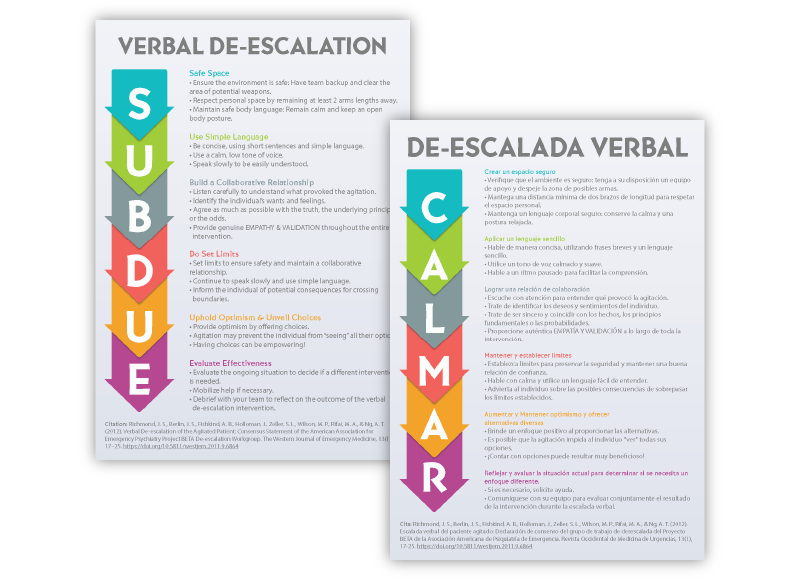
Verbal De Escalation Pocket Card (English and Spanish)
Verbal De-escalation can be useful in situations when a person is showing overt signs of escalating agitation. This pocket card is a quick and easy way to remember how to appropriately engage in a Verbal De-escalation intervention.
Download the Pocket Card
Publications
Crisis Services: Meeting Needs, Saving Lives
This book is composed of SAMHSA’s “National Guidelines for Behavioral Health Crisis Care: Best Practice Toolkit” and related papers on crisis services. The toolkit reflects relevant clinical and health services research, review of top national program practices and replicable approaches that support best practice implementation. The related papers address key issues relevant to crisis services, homelessness, technology advances, substance use, legal issues impacting crisis services, financing crisis care, diverse populations, children and adolescents, rural and frontier areas, and the role of law enforcement.
Webinars & Online Learning
Current News & Research
Cultural Guideposts of Health: A crisis response evaluation framework for California’s diverse Indigenous communities
This paper describes the development of a culturally grounded crisis response evaluation framework called Cultural Guideposts of Health, created for California's American Indian and Alaska Native (AI/AN) communities. Built on a Culture-as-Health framework, a Guiding Coalition of Traditional Healers, Knowledge Keepers, community members, and people with lived experience worked alongside academic researchers to create a model that centers Indigenous definitions of health and wellness across four domains: Spirituality, Cultural Practices, World View, and Place-Based Sacred Sites. The result is an adaptable toolkit designed to evaluate crisis response and other interventions across diverse Tribal and urban AI/AN contexts, with pilot testing planned as a next step.